1. Gather the scans
Not one. Not two. The full history - across providers, systems, and time.
VisitVizor brings everything into one place.
VisitVizor
Loading your workspace
Preparing your dashboard, records, and imaging tools.
LONGITUDINAL CARE
Imaging. Labs. Medications.Over time.
See the whole picture.
VisitVizor CT Jump in Time and Longitudinal Analytics
CT scans were built to analyze and diagnose a single moment.
One scan.
One coordinate system.
One reference point.
They were never designed for longitudinal study.
But conditions like cancer don't exist in a single moment.
They evolve.
Now you can follow care across time.
Bringing all scans together. Aligning them. Making them searchable by point.
With VisitVizor:
Not one. Not two. The full history - across providers, systems, and time.
VisitVizor brings everything into one place.
Scans are taken at different times, positions, and orientations.
VisitVizor aligns them — so you are looking at the same anatomy across time.
Not by file. By location.
Find a point in one scan - and see that same point across every scan.
Select a series of scans.
Set a reference point.
Jump forward and backward - in the same location.
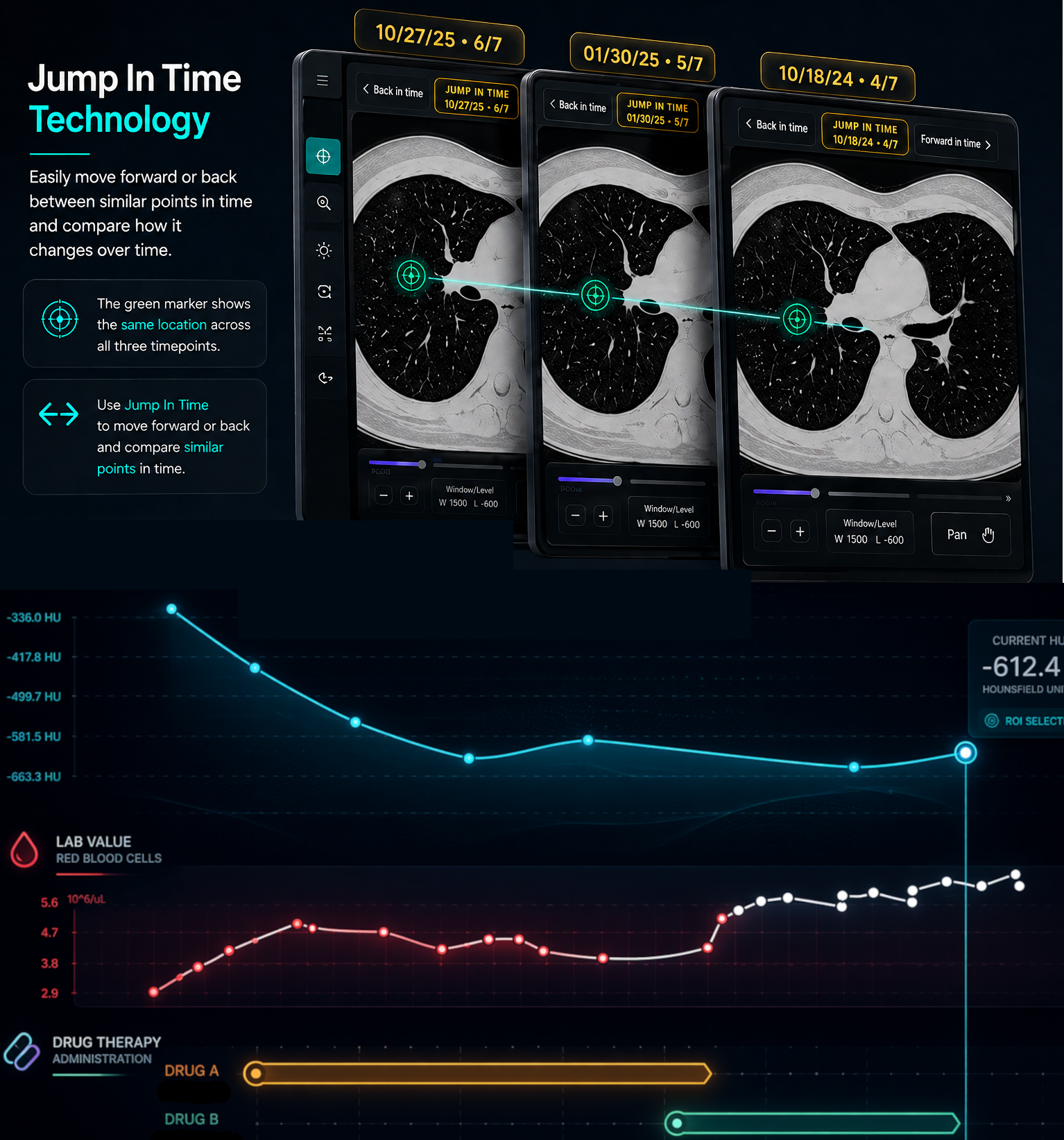
Define a region of interest.
Track it across every scan in the series.
Measure how it changes over time.
Imaging. Labs. Medications - aligned.
These views can help show treatment response over time by connecting imaging change with labs and medications.
Patients can see what is actually happening - not just read reports.
They can understand change over time visually.
They can bring the view into the conversation with their doctor, right on the patient's phone.
Physicians can see imaging changes alongside treatments, labs, and the patient's broader timeline.
Not just static snapshots. Context across time.
Longitudinal imaging, treatment timelines, and lab values can support patient-driven real-world research when patients choose to participate.
When imaging, labs, medications, and time are finally aligned, patients and doctors can see the whole picture.